When I started shaping Vorgar, I did not want replayability to come only from adding more and more rules. I wanted the map itself to do a lot of the work. If the same basic actions can lead to a different position, a player can return to the game without needing a huge rulebook.
That is why city starts, map slots and game modes matter so much. A match is not only different because the terrain looks different. It is different because the first decision is already happening in a new context: where are my cities, where are the mines, which border is dangerous, and how soon will another player become a problem?
That is the part I find exciting as a developer and as a player. A simple system can stay readable while still producing a lot of different board stories.
The rules are intentionally small, but the opening position should not feel solved before the first turn begins.
One city can already change the plan
In Classic mode, each player starts with one city. That sounds very clean, and it is. But the city does not have to create the same plan every time.
Maps can contain multiple start slots, and the game chooses valid starts for the active players. That means one match might begin with a safe city near local gold, while another match puts early pressure closer to a bridge, a valley, an island crossing or a contested center. The core rule is still simple: protect your city, expand, gather gold and raise armies. The plan around that rule changes.
I like that because it keeps the first few turns easy to understand. A new player can see the city and know it matters. A returning player can look at the same rule and ask a better question: what kind of city start did I get this time?
Kingdom makes the opening wider
Kingdom mode pushes that idea further by starting each player with three cities. Three cities create more economy, more responsibility and more possible mistakes.
Sometimes those cities can feel like a compact kingdom that is easier to defend from the beginning. Sometimes they can be spread across a more dangerous shape, closer to other players or to contested routes. That changes the mood of the match very quickly. Do I protect the whole kingdom? Do I abandon one exposed city to grow elsewhere? Do I push toward mines before someone else builds momentum?
Those are the kinds of decisions I want Vorgar to create. Not a wall of complicated commands, but a board position that quietly asks: what are you willing to risk?
Conquest starts closer to war
Conquest is the most direct version of this replayability idea. Instead of beginning from a tiny base and slowly claiming the board, Conquest can distribute starting territory and pressure much earlier. It can feel more like the war has already begun and the player has to make sense of a front line immediately.
That creates a different kind of tension. In Classic, the question is often where to expand first. In Kingdom, the question is how to manage several valuable cities. In Conquest, the question can become much sharper: which border is already weak, where can I break through, and what must be defended now?
For me, that is a useful direction for the game. The same ingredients are still there: cities, armies, gold mines, hexes and territory. But the starting arrangement changes how those ingredients behave.
Maps are more than backgrounds
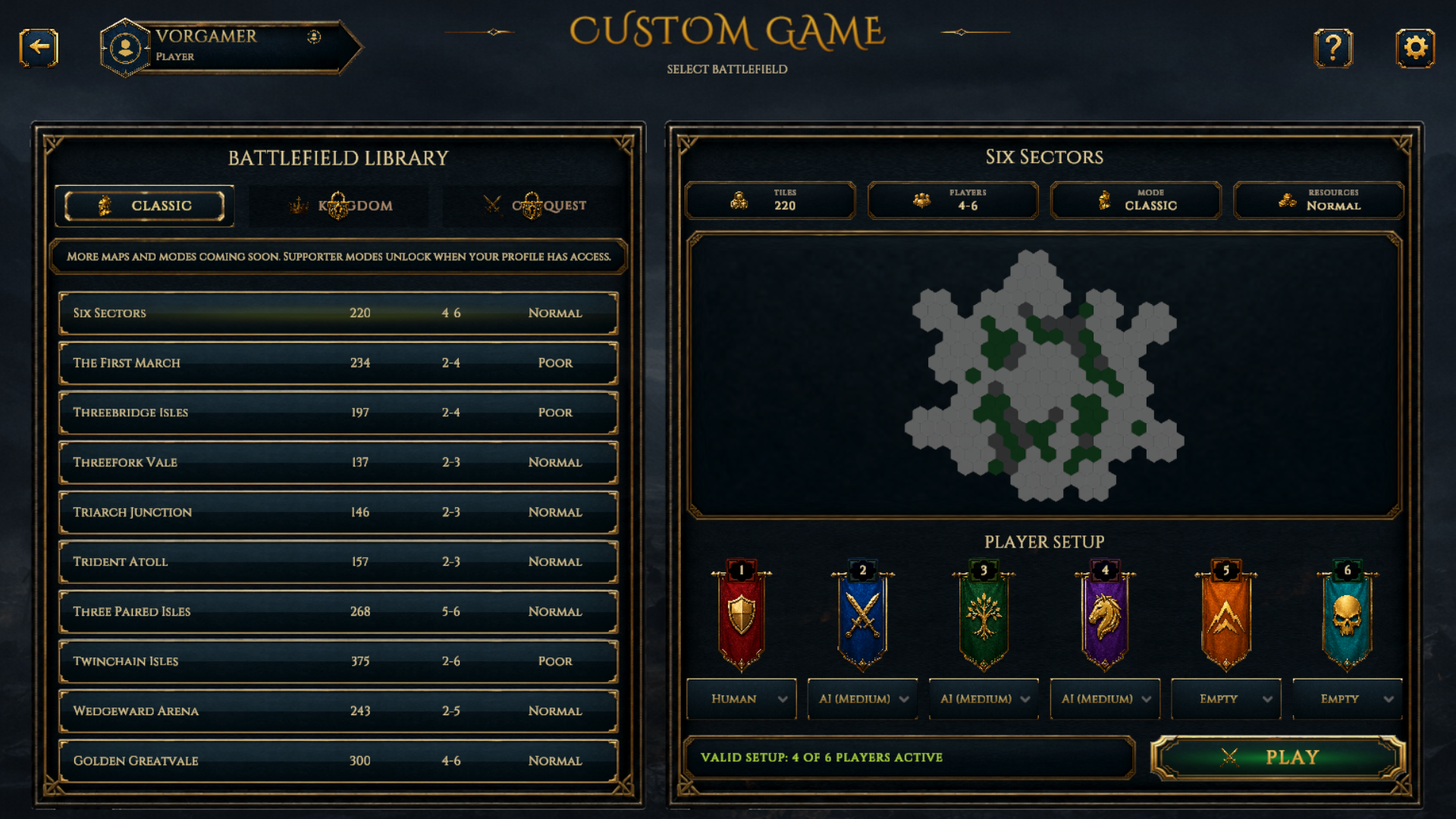
The map pool is one of the main ways Vorgar can grow. Some maps use islands and bridges. Some use rings, valleys, sectors, central pressure, shore routes, mountain blockers, forest gates or scattered towns. I do not really have one favorite map, because the whole point is that different layouts create different questions.
A narrow bridge can make one army stack feel important. A wide open center can punish a player who spreads too thin. A rich gold valley can tempt everyone into the same dangerous region. Several neutral towns can create a race before the real fighting even starts.
This is also why I want map feedback from players over time. If someone has an interesting map idea, a strange setup, or a layout that creates good tension, I want to be able to look at it and bring the strongest ideas into the game as curated maps. Vorgar does not need every possible map. It needs maps that create readable decisions.
Online makes the variation human
Computer opponents are useful, and I still want them to keep improving. But online play changes the feeling of replayability because the other side is no longer just a system. It is another player with a different appetite for risk.
One player might defend carefully and build economy. Another might rush toward mines. Another might attack too early, lose momentum, and still change the whole match because everyone else has to react. The map creates the board story, but online players give it personality.
Online play is already playable in Vorgar, and I want more players to try it. The player base is still growing, so every new person matters more than they might think. A lobby with real opponents makes the game feel more alive, and every completed match gives me a better picture of what should be improved next.
Future ideas like seasons, rankings, rewards, new modes and more map work can make online stronger later. I do not want to pretend those systems are already finished. The important foundation is simpler: players can already meet on the map, and every opponent can make the same rules feel different.
The goal is replayability without noise
There is always a temptation to make a strategy game bigger by adding more systems. Sometimes that is the right path. But for Vorgar, the stronger foundation is a small ruleset that can support many situations: one city, three cities, wider conquest starts, different maps, different resources and different opponents.
That keeps the game easier to learn while giving it room to grow. More modes and better maps can come later, but they should strengthen the same idea: simple rules, clear pressure and enough variation that the next match is worth starting.
That is the promise I am trying to build toward. Not endless content for the sake of a number, but a game where the board can keep asking new questions.