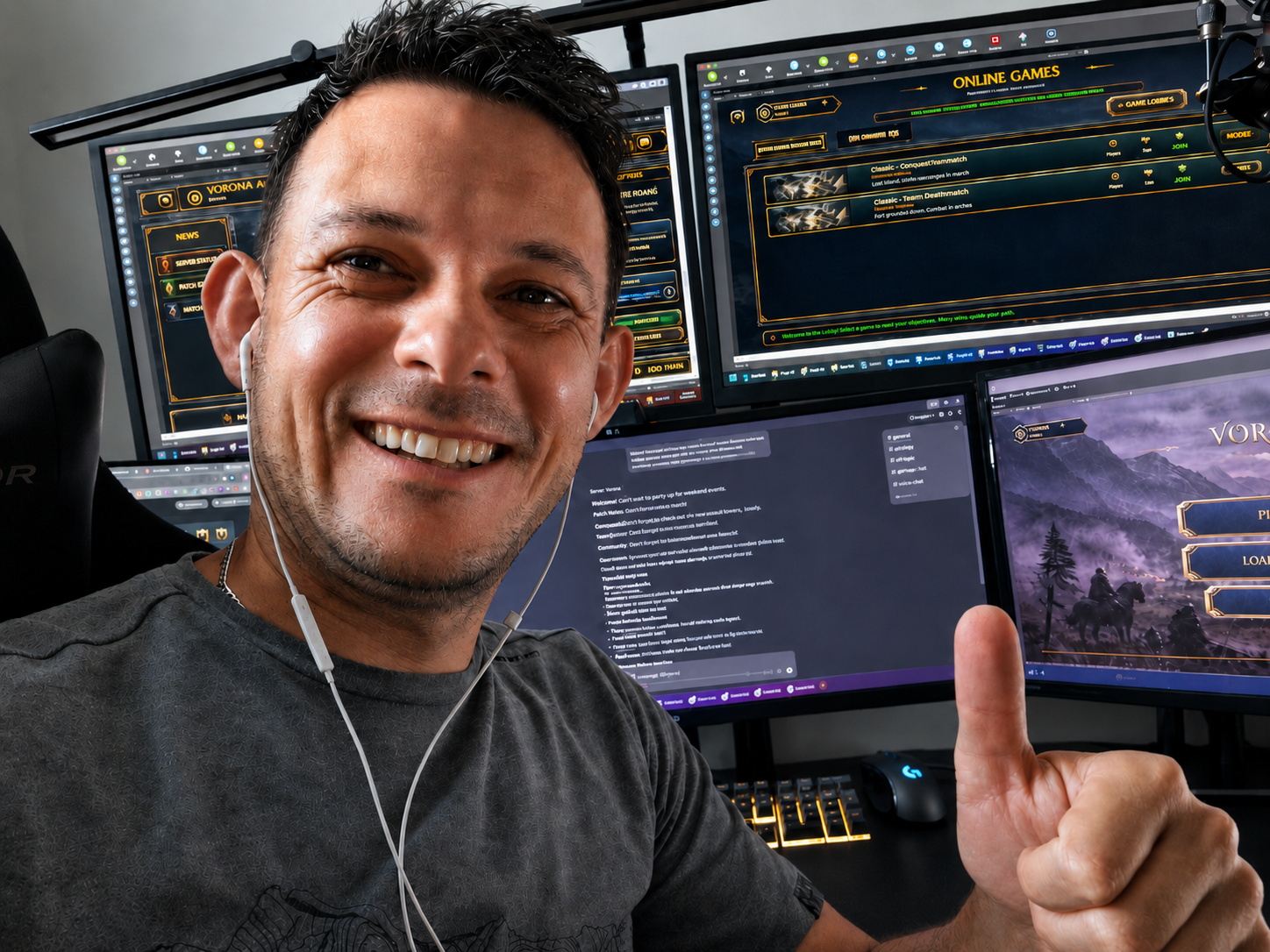
Most days, the real work on Vorgar starts very late. The day job is finished, the children are finally asleep, and the next morning is already waiting with school runs, work, house tasks and everything else that does not care whether a map screen still needs one more pass.
That is the honest rhythm right now. I work heavily in IT, but I am not primarily a game developer. Every new tool, build problem, store requirement, UI decision or gameplay bug can become the challenge of the day. The project has to move through learning, testing and a lot of trial and error.
The difficult part is not switching from IT to game development. I switch tasks quickly; that is normal in my work. The harder part is finding a quiet head at all. Remote work has a strange edge: there is no journey home, no physical line that says the workday is over. One room closes, another room opens, and family life reasonably expects me to be fully present immediately.
The project is being built in the gaps, but it is not a gap in ambition.
Using small windows well
AI tools changed what those small windows can do. I do not have to sit alone with every line of code, every possible structure, or every next step. Sometimes the best use of a free minute is to give Codex a focused instruction, review a suggestion, check a command, or steer a task while I am between other responsibilities.
That does not make the project automatic. I still have to decide what belongs in the game, what should be cut, what feels readable, and what is honest enough to show publicly. But it means that a short pocket of time can still create movement. A question can become a plan. A plan can become a file change. A file change can become one small improvement in the build.
Sometimes that happens at the computer. Sometimes it starts from a phone. Sometimes it happens while the house is moving around me: cleaning, organizing something for the children, checking a command between ordinary tasks. It is not the cleanest way to build a game, but it is the way that keeps the project alive right now.
Chaos is part of the schedule
With small children, there is rarely a perfect moment where the day is neatly finished and the desk is waiting in silence. There is movement, noise, care, logistics and the constant feeling that something else also needs attention. There is not a large local support net that can simply take over for half a day whenever rest would be useful.
On top of that, life is not only the game. There is a plot of land to prepare for a future house, practical work outside, and even things like building a playground for the children. Those are good parts of life, but they still take time and energy. Vorgar is being made around all of it.
Going outside helps. A bike ride, a playground visit, or just leaving the work room gives the mind a cleaner break than staying in the same place all day. Often the best version of the evening is not forcing one more tired hour immediately after work. It is stepping out, coming back later, and using whatever focus is left with more intention.
The first release took a cost
The first Google Play release was hard. I was still learning the tools, the workflow, the build process and the shape of the game itself. For a few months, I pushed extremely long days, often well beyond a normal workday, because I wanted to get the first version out and prove that the project could exist outside my own head.
After that, I needed a break. For about two months, I stepped back, rested, handled family and practical work, and let the project breathe. That pause was not a failure. It was part of understanding that a one-person project cannot run forever on overload.
When I returned, I came back with clearer eyes. The next big step was a full redesign pass. The current version feels much closer to the direction I want for Vorgar: more polished, more consistent, easier to extend, and built around better UI decisions that can now grow in smaller steps instead of another full redesign. I am much happier with it now, even while I can still see how much work remains.
Of course, there were mistakes along the way. Some decisions were wrong, some were simply part of learning, and some only showed their limits after the game was already playable. That is normal. The important thing is to keep moving, analyze what happened, understand the lesson, and make the next version stronger.
Why I keep going
The hardest part is that I cannot give Vorgar one hundred percent of my working life yet. That is the honest limit. But it is also the reason I keep using every useful tool and every available moment: I can see a future where Vorgames becomes a bigger part of that life.
For now, the work has to be practical. One feature, one screen, one note, one screenshot, one public update. The goal is not to pretend this is already a full-time studio. The goal is to keep building until the project earns more space.
If you want to see what all those late sessions are turning into, start with the Vorgar project page. For shorter updates from the ongoing work, you can also follow Vorgames on TikTok, Instagram, YouTube or Facebook.